
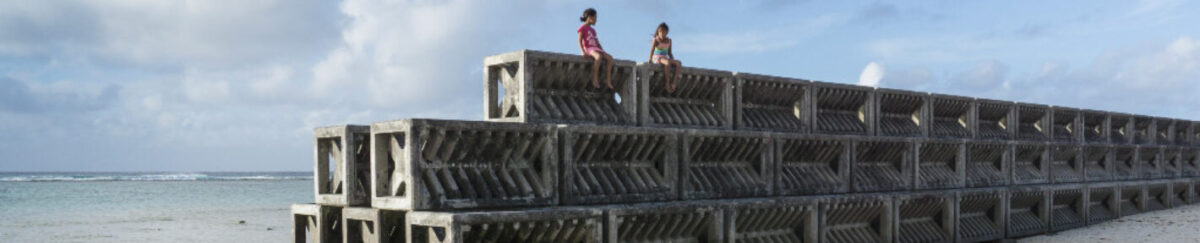
WASCAL master’s students explore environmental and climate justice using photographic methods in Cape Verde
How can photography and visual methods help to make conflicts and issues of justice visible in the context of environmental and climate justice? This question was the focus of a three-day course for West African students, which took place from February 18 to 20, 2026, as part of the WASCAL program “Climate Change and Marine Sciences” in Mindelo, Cape Verde. A total of 15 master’s students from 12 countries took part. WASCAL stands for West African Science Service Centre on Climate Change and Adapted Land Use and aims to train the next generation of researchers in the field of marine and climate sciences.
Hamburg-based documentary photographer Barbara Dombrowski and Kiel-based human geographer Professor Dr. Silja Klepp, co-holder of the UNESCO Chair in Integrated Marine Sciences at Kiel University, jointly led the intensive workshop entitled “Tackling marine conflicts with art-based methods.” The two have a long history of collaboration: Together, they have researched topics such as climate justice in the Pacific—for example, in Kiribati—and progressive coastal erosion in Sicily, developing unique visual formats that bring scientific findings to life.
«Artistic methods open up new approaches to scientific questions. They enable us not only to analyze injustices, but also to make them visible and tangible, thereby creating new spaces for dialogue and change,» explains Silja Klepp, who heads the Social Geography of Coastal and Marine Areas research group at Kiel University (CAU).
Putting student voices at the forefront
The workshop did not center on the teachers, but primarily on the students themselves. Using the PhotoVoice method — a participatory and inclusive research approach that uses photography as a tool to make their own perspectives and living environments visible — the students developed their own topics related to conflicts and injustices in the marine and coastal areas.
The first day laid the conceptual foundation: Silja Klepp introduced the field of environmental justice and asked why artistic research can play a role in one’s own scientific questioning. Barbara Dombrowski then used examples from her own work to show how documentary photography can convey scientific content in an emotionally and socially compelling way. The students then worked together in small groups to develop their topics for the following day’s excursion.
“I am impressed by how quickly the students immersed themselves in the topics and how thoughfully they engaged with the content and translated it into images. They learned that photographs can reach people on an immediate level, condense complex relationships, and create empathy — especially on topics that often seem abstract,” says Barbara Dombrowski.
Out into the field – photographic research in Mindelo
The second day was devoted to practical work: armed with their cameras and cell phones, the groups set out into their surroundings to conduct photographic research. They visited relevant locations, spoke with local stakeholders, and translated their topics into visual narratives. Barbara Dombrowski and Silja Klepp accompanied this process with mentoring and remained available for questions and discussion throughout.
Research with impact
On the third and final day, the students returned to the seminar room to view, edit, and present their photographs. Each group presented their work, followed by feedback and a joint discussion in plenary. The workshop concluded with a reflection session in which the experiences of the workshop were evaluated. The resulting photographic works are not only intended as seminar products. They are to be used for exhibitions and other public events, thus contributing to the social debate on environmental and climate justice.
About the lecturers
Silja Klepp is Professor of Human Geography at Kiel University, co-holder of the UNESCO Chair in Integrated Marine Sciences at Kiel University, and co-founder of the Environmental Justice Network EnJust. Barbara Dombrowski is a member of the renowned photo agency laif and has portrayed indigenous communities on all five continents in her work “Tropic Ice.” She was the official exhibition partner of the UN and the city of Bonn at COP23.
About the UNESCO Chair in Integrated Marine Sciences at Kiel University
About the WASCAL Master’s course
In addition to lectures and practical courses, the program also includes a research stay for master’s theses and a two-week seagoing training component called “Floating University,” which is coordinated at GEOMAR Helmholtz Centre for Ocean Research Kiel. In May, the students, including a member of FYORD, the joint program for early career researchers of GEOMAR and the priority research area Kiel Marine Science (KMS) at Kiel University, will be introduced to scientific oceanographic work aboard the Polarstern. Hamburg photographer Barbara Dombrowski will accompany the expedition.
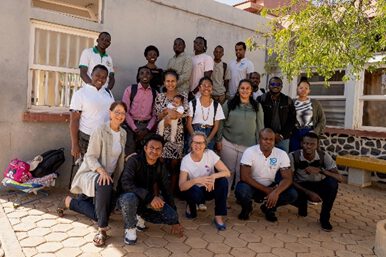
Students of the master’s program “Climate Change and Marine Sciences” in Mindelo, Cape Verde, with their lecturers Barbara Dombrowski (front row, left) and Prof. Dr. Silja Klepp (front row, center).
Photo: WASCAL
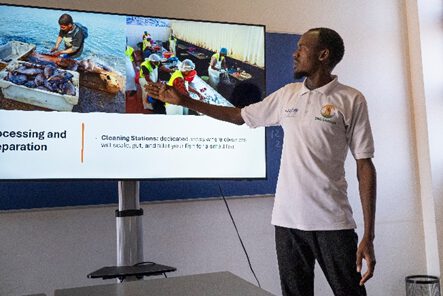
The participants in the WASCAL program developed their own research topics, which they visualized using visual methods and a participatory approach. Here, the focus was on the fish processing activities at Mindelo market.
Photo: Barbara Dombrowski
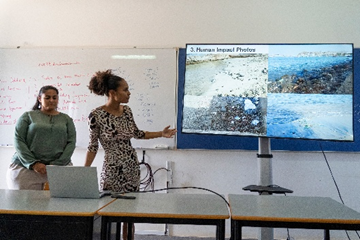
The human impact on the marine and coastal environment was the focus of the three-day seminar in Cape Verde. The master’s students developed their own perspectives and translated them into photographs. The topic here was waste from the fish market and the resulting challenges for fishermen and the environment.
Photo: Barbara Dombrowski
Kontakt: Silja Klepp